 The moment began not with outrage, but with a clip—quiet, archival, and devastatingly clear. On a recent episode, Stephen Colbert reached back more than two decades to resurrect a long-forgotten interview featuring a younger Donald Trump. What followed was not a typical late-night punchline, but something sharper: a side-by-side confrontation between past words and present actions.
In the 2004 interview with Larry King, Trump was asked a deceptively simple question: what does it mean to betray your country? His answer was strikingly direct. Betrayal, he said, meant putting yourself above the Constitution, using power for personal gain, refusing to accept when the system tells you no, and acting as if the rules do not apply to you.
At the time, the statement sounded like a conventional reflection on civic values. There was nothing controversial about it. In fact, it carried a tone of clarity—almost moral certainty. But Colbert understood something crucial when he rediscovered that clip: definitions matter most when they are tested against behavior.
So he pressed play again—this time with context.
Colbert didn’t interrupt the footage or layer it with heavy commentary. Instead, he let Trump’s 2004 voice linger in the air before cutting to moments from the years that followed, particularly from 2020 onward. The contrast wasn’t forced. It was
When Trump said “putting yourself above the Constitution,” Colbert followed with clips referencing claims of broad executive power and immunity. When Trump described “refusing to accept when the system tells you no,” the show cut to footage of election disputes and repeated rejections by courts. The sequence unfolded like a checklist—one that appeared eerily complete.
What made the segment resonate wasn’t satire alone. It was the absence of interpretation. Colbert didn’t need to argue his case. The argument had already been made—by Trump himself, years earlier. The audience wasn’t told what to think; they were invited to observe a pattern.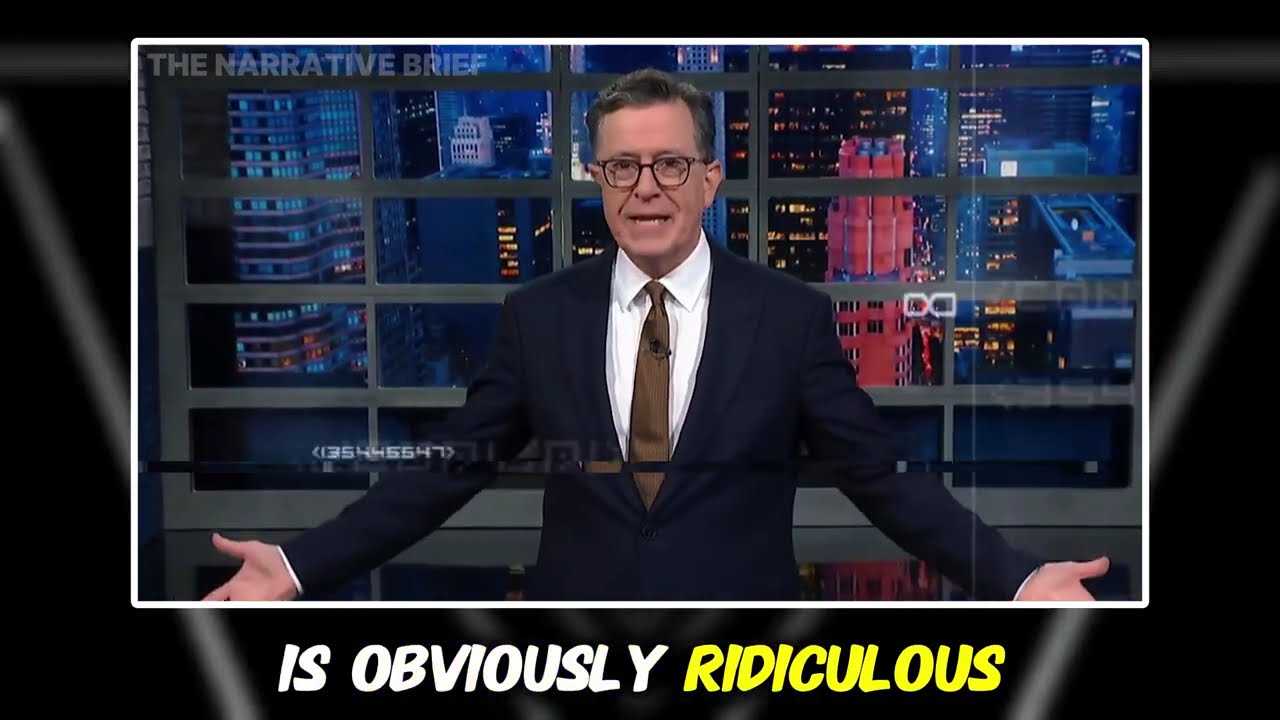
And that pattern proved difficult to ignore.
The audience reaction shifted from laughter to something closer to recognition. This wasn’t about partisan debate or ideological framing. It was about consistency—or the lack of it. When a public figure defines a principle so clearly, the expectation is that they will be measured by it. Colbert simply applied that standard.
In doing so, he reframed the conversation. Instead of asking whether Trump’s actions were right or wrong, he asked something more precise: do they match the definition Trump once gave? It’s a subtle shift, but a powerful one. It removes opinion and replaces it with comparison.
There’s also a deeper implication beneath the surface. Public figures often rely on narrative control—shaping how their actions are interpreted. But recorded statements, especially those made without immediate political pressure, can act as anchors. They limit how far a narrative can drift.
Colbert’s segment demonstrated that clearly. A statement made in 2004, preserved on tape, became a lens through which recent history could be examined. Not reinterpreted. Not spun. Simply replayed.
In the end, the impact wasn’t about comedy. It was about alignment. When past and present collide so directly, the result doesn’t feel like an attack. It feels like exposure. And once that connection is made, it becomes difficult to unsee.
Because sometimes, the most powerful critique isn’t built from new arguments—but from old words, spoken long before anyone realized how important they would become.

What followed after the segment aired was not immediate consensus, but a widening ripple of interpretation. Across social platforms and commentary circles, viewers returned to the same question Colbert had implicitly raised: when a public figure’s own language becomes the measuring stick, how much room is left for reinterpretation?
Some viewers framed the clip as a straightforward act of accountability journalism—an illustration of how historical statements can be re-examined in light of later events. Others saw something more deliberate in the sequencing, arguing that editing choices inevitably shape perception, even when the source material is unchanged.
The debate did not center on whether the 2004 interview was authentic—it clearly was—but on what it meant when placed against the backdrop of two decades of political evolution.
What stood out most, however, was the emotional response rather than the ideological one. Many viewers described a sense of dissonance: not because they were hearing something new, but because they were hearing something familiar reframed in a way that felt unavoidable.
The effect was less about revelation and more about reconnection—linking words once treated as abstract principles to moments that have since become heavily scrutinized in public memory.
Media analysts noted that this type of “self-referential critique” is increasingly common in modern broadcast commentary. Rather than relying solely on external accusations or partisan framing, programs are returning to archival material as a way of constructing narrative tension. In this format, the subject’s own voice becomes the primary source of evaluation, and the role of the presenter shifts from commentator to curator.
Yet even within that structure, interpretation remains unavoidable. The decision to juxtapose specific clips, the pacing between them, and the absence of verbal interruption all contribute to how the audience experiences meaning. Silence, in this context, functions almost like emphasis. What is not said can sometimes carry as much weight as what is.
By the end of the segment, Colbert did not offer a concluding judgment. There was no explicit verdict delivered to the audience, no summarizing statement to close the loop. Instead, the final image lingered: Trump’s earlier words, left unresolved, echoing against the timeline that followed.
And perhaps that was the point. Not to resolve the contradiction, but to leave it suspended—visible, measurable, and intact.
Because once past statements are placed side by side with present realities, the viewer is no longer guided toward an answer. They are left to navigate the comparison themselves. And in that space between memory and moment, interpretation becomes unavoidable.