Keith Thompson

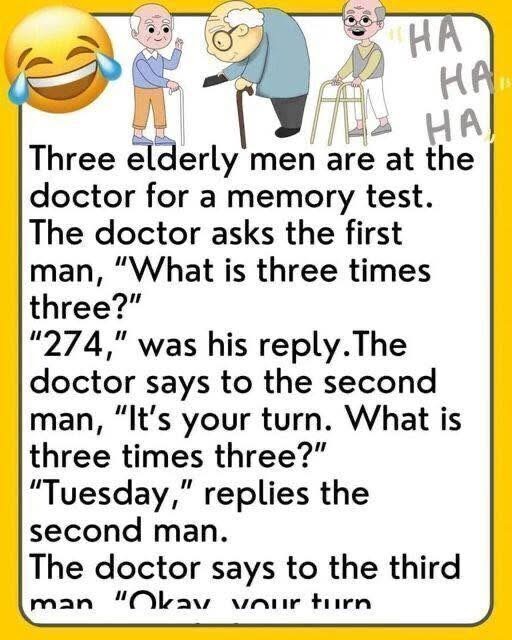
Three Elderly Friends Walk Into a Doctor’s Office for a Memory Test — What Happens Next Turns Into a Hilarious, Emotional Journey About Aging, Friendship, Laughter, Resilience, and the Beautiful Way Seniors Hold On to Joy Even When Memories Begin to Slip Away

Aging didn’t scare them. Losing themselves did. Three lifelong friends walked into a doctor’s office expecting quiet dread — and walked out with a story that would outlive their sharpest memories. One absurd answer. One roomful of stunned silence. Then an explosion of laughter that changed how they faced everything that came afte… Continues…


They never did learn to stop misplacing keys, names, or entire stories midway through a sentence. But after that day in the doctor’s office, the fear around it loosened. Their forgetfulness stopped feeling like a private failure and became a shared joke, a gentle language only they fully understood. “Subtract 274 from Tuesday” turned into a code for: we are still here, we are still us, even when the details slip away.In the slow drift of their later years, they discovered that memory was not the only proof of a life well lived. The proof was in the way they waited for each other at the diner, in the way they filled in one another’s missing pieces, in the way they chose kindness over correction. They couldn’t always trust their minds, but they could trust their bond. And in the end, that was the truest kind of remembering.

Justin Bieber Admits That He Tested Positiv!

Justin Bieber has lived most of his life in the public eye, rising to fame at a young age and growing up in front of millions of fans and critics around the world. His journey from a small-town Canadian kid to an international pop sensation has been widely celebrated—but also intensely scrutinized.

As he navigated his teenage years, Bieber experienced both massive success and overwhelming pressure. While his music career skyrocketed, the weight of fame and constant public attention began to take a toll on his personal life and mental health. Fans watched as the boy-next-door image began to fade, revealing the struggles beneath the surface.

One of the most pivotal and troubling moments in Bieber’s young adulthood occurred in 2014, when he was arrested in Miami at just 19 years old for driving under the influence (DUI). The news shocked fans and critics alike, casting a shadow over his carefully crafted teen idol persona.

The incident marked a dramatic turning point in how the world viewed Bieber. Once seen as a clean-cut heartthrob, he now faced serious legal and personal challenges. The arrest symbolized the growing disconnect between his public image and his private reality, forcing both Bieber and his supporters to confront the darker sides of fame.

In later interviews, Bieber openly reflected on that night, acknowledging how out of control his life had become. His candid admissions helped to humanize his struggles and sparked conversations about mental health, celebrity culture, and the pressures young stars often face.

Though that chapter was a low point, it also served as the beginning of a longer journey toward redemption. Bieber has since taken steps to rebuild his life and career, focusing on personal growth, music, and reconnecting with his faith and values.

YOUR BRAIN WILL SEE SOMETHING IT SHOULDN’T — AND YOU CAN’T UNSEE IT

At first glance, this photo looks completely harmless. Just pillows. A bed. Nothing more. But then your eyes pause for half a second longer than usual — and suddenly, your brain flips the script.

People swear they noticed “it” instantly. Others insist it took a few seconds. But once you see it, the image changes forever. What looked innocent seconds ago now feels… strangely suggestive. And that’s exactly why this photo exploded online.

The shapes, the curves, the shadows — they line up in a way that feels almost intentional. But it isn’t. There’s no trick editing here. No Photoshop. Just fabric, folds, and your imagination doing the rest of the work.

Psychologists say this happens because the human brain is wired to recognize bodies before objects. When patterns accidentally resemble something intimate, your mind fills in the gaps — fast. Faster than logic can stop it.

What makes this image even more addictive is how personal the reaction feels. Some viewers laugh. Some blush. Others scroll back up just to check if they’re imagining things. Spoiler: you’re not alone.

Social media users couldn’t agree on what they saw first — and that debate made the image spread even faster. The comments turned wild. Some said it was “too obvious.” Others claimed they saw nothing at all… until someone pointed it out.

That’s the power of visual suggestion. Once planted, it takes over. The mind locks onto the illusion and refuses to let go, replaying the image with a new meaning every time.

So look once. Look twice. And be honest with yourself — because this photo doesn’t reveal anything about the bed…

It reveals everything about how your mind works.

The Meaning of the Intriguing Gesture of Scratching the Palm of Another Person’s Hand

The gesture of scratching the palm of another person’s hand is one of those subtle actions that often goes unnoticed by outsiders, yet it can carry layers of meaning depending on context, culture, and relationship. At first glance, it may seem accidental or playful, but such gestures are rarely random. Human touch has always been a powerful form of communication, sometimes expressing emotions more honestly than words ever could. A light scratch on the palm can be a quiet signal, delivered discreetly, meant only for the recipient to understand. Because it happens in such an intimate space—the palm being one of the most sensitive areas of the body—it naturally draws attention and creates a moment of connection between two people.In many social and cultural interpretations, scratching the palm is often associated with flirtation or romantic interest. The palm is closely tied to intimacy, trust, and vulnerability, so touching it in a deliberate way can suggest attraction or a desire to deepen a bond. In some cultures, especially in subtle courtship traditions, this gesture has been used as a nonverbal way to express interest without openly declaring it. It allows one person to test boundaries while still maintaining plausible deniability. If the gesture is returned or welcomed, it can signal mutual attraction; if ignored, it can quietly fade without embarrassment.

However, the meaning of this gesture is not always romantic. In certain situations, scratching the palm can be playful, comforting, or even symbolic of reassurance. Between close friends or family members, it may simply be a teasing habit or a calming motion meant to convey support. The intention behind the gesture matters just as much as the action itself. The pressure, duration, and timing all play a role in interpretation—whether it’s a brief, light touch meant to get attention, or a slower, deliberate motion suggesting something more emotionally charged.

Ultimately, the intriguing nature of scratching another person’s palm lies in its ambiguity. It exists in the gray area between innocence and intention, making it powerful precisely because it is open to interpretation. Context is everything: the setting, the relationship, and the accompanying body language all shape its meaning. What remains consistent, though, is that such a gesture invites awareness—it asks the recipient to feel, notice, and interpret. In a world dominated by spoken and digital communication, these quiet, tactile signals remind us that human connection often speaks loudest without making a sound.

Understanding What’s Really Going On Behind the Scenes

Public debates about what courts choose to reveal and what they keep confidential often lead to confusion. Many people assume that every redacted document or limited statement hides something significant. In reality, trust in the justice system is built less on total transparency and more on clearly explaining how decisions about disclosure are made.

When courts outline the rules that guide what can be shared, they turn what might look like secrecy into an understandable process. Even if people don’t get every detail, they can grasp the reasoning behind restrictions. That clarity helps the system feel less mysterious and more predictable.

Instead of guessing why information is withheld, the public can see the standards that shaped the choice. Over time, these steady explanations become more valuable than any single release of documents. Consistency builds confidence.

Disagreements will still happen. Some will argue documents should have been shared earlier, or that explanations were too vague. Others may question whether certain information truly required confidentiality.

Yet when people can connect outcomes to stated rules instead of imagined motives, criticism becomes more focused and productive. The conversation shifts from “What are they hiding?” to “Are these guidelines fair and reasonable?”

In this type of environment, trust doesn’t require blind faith. It grows through repeated, reliable communication. Courts demonstrate responsibility not by revealing everything, but by making the boundaries of disclosure understandable.

Even when certain details must remain private, courts remain accountable when the structure behind their decisions is clear. People know what to expect and why.

That steady openness — explanation rather than complete exposure — helps maintain public confidence, even during sensitive or controversial cases.

What do some spiritual traditions believe about what happens when you visit the grave of a loved one?

When someone we love leaves this world, we not only lose their physical presence, but also a silent question that accompanies us day and night.Does he/she still feel me?
Does he/she know I remember him/her?

Does he/she see me when I go to his/her grave?

For many, the cemetery becomes a sacred place. A space where silence seems to speak and where the heart finds a way to weep without words. For others, however, that place is too painful, an open wound that is difficult to face. Both reactions are valid.

But there is a spiritual truth that is often not clearly stated: love does not live in a grave; it lives in the energy that unites two souls.

The body remains, the soul continues.

When a person dies, their body returns to Earth, but their essence does not disappear. The soul is not made of matter; it is not enclosed in a coffin nor trapped in a tombstone.

The body was merely an instrument for living on this plane, but the soul continues its journey to other levels of existence.

It’s like taking off old clothes: what matters isn’t the garment left behind, but the person who wore it.

That’s why our loved ones aren’t bound to the place where their remains rest. They can be with us at home, on the street, in our memories, and in our most intimate thoughts.

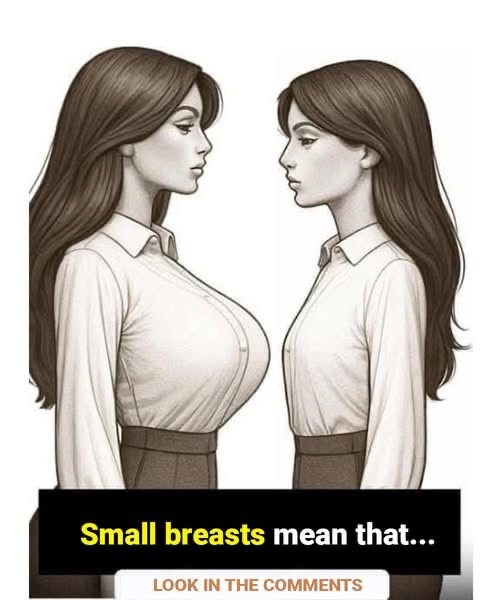
Understanding the Relationship Between Breast Size and Hormonal Health

Breast size is primarily influenced by genetics, hormones, age, weight, and lifestyle choices. While it’s a common point of curiosity and cultural focus, breast size does not determine overall health or indicate hormonal balance. The belief that smaller breasts signify poor health or reduced femininity is a myth that lacks scientific backing.

Health is a complex interplay of many factors, and body shape alone cannot provide an accurate picture.Judging someone’s wellness based on physical traits like breast size promotes harmful stereotypes and ignores the more significant health indicators such as energy levels, metabolism, immunity, and mental well-being.

Some studies have observed correlations between larger breast size and higher risks of certain conditions like type 2 diabetes. However, this link is often due to body weight rather than breast size itself. Heavier individuals may store more fat in various areas, including the chest, which is a reflection of general body composition—not a direct health concern related to the breasts.

Each woman’s body is unique, and variation in breast size is completely normal. Rather than focusing on appearance, prioritizing healthy habits is far more beneficial to long-term wellness. What matters most is how the body functions and how it’s supported through lifestyle.

Maintaining hormonal balance involves nurturing your body through proper nutrition, physical activity, and stress reduction. Natural remedies like sage tea or maca root, and supplements can be helpful, but they should be used under medical supervision to ensure safety and effectiveness.

Ultimately, breast size does not define a woman’s health or femininity. True well-being comes from how you care for your body, not how it looks. Respecting and supporting your body’s natural form is essential to building confidence and sustaining good health.

The House passed a bill seeking to ban gender transition–related medical treatments for minors, marking a significant step in an ongoing national debate. Supporters argue the measure protects children from irreversible decisions, while critics say it interferes with medical judgment and family choice. The bill now moves forward amid legal, political, and public scrutiny.

The House vote to criminalize gender-affirming care for minors wasn’t just another partisan clash; it was a deliberate escalation in a culture war that now reaches into exam rooms and living rooms. Supporters spoke in absolutes, insisting they were rescuing children from irreversible harm, casting doctors as predators and parents as misled or untrustworthy. Opponents countered with statistics, medical consensus, and lived experience, warning that the law would rip away care that many families say keeps their children alive.Behind the numbers and slogans are frightened teenagers, exhausted parents, and physicians suddenly wondering if following clinical guidelines could cost them a decade in federal prison. The bill is unlikely to survive the Senate unchanged, but its passage in the House redraws the political map. It signals that transgender youth have become a central test of power, ideology, and whose judgment counts in the most intimate decisions a family can make.

What the Number of Triangles You See Reveals About Your Personality and Perception

At first glance, it looks like nothing more than a bright pyramid of colorful triangles — a fun little puzzle floating across social media. Yet the longer you stare at the image, the more your mind starts to shift. Some people count 9 triangles. Others see 13, 16, or even more than 20. And somehow, each person feels convinced their number is right.

This simple optical illusion has captured millions of curious minds not because it’s a math challenge, but because it touches something deeper — the way we see, think, and interpret the world around us.

The Hidden Psychology Behind the Triangles

What’s happening here isn’t just about eyesight or counting skills. Psychologists would call it a Gestalt perception — our natural tendency to view patterns as unified wholes instead of separate parts.

Your brain decides almost instantly whether to focus on the smaller details or to piece them together into something larger. That snap decision says something fascinating about how you process life, relationships, and even emotions.

Some of us notice order and structure. Others see possibility and meaning in the smallest corners. Neither is right or wrong — they’re just different ways the mind organizes the world.

If You See 9 Triangles

You’re probably a realist at heart. You notice what’s in front of you and trust the facts you can verify. People like you value honesty, practicality, and clear results. You don’t chase after illusions or get swept away by “what-ifs.”

In everyday life, this mindset helps you stay grounded. You handle challenges by breaking them down step by step. But the same focus on the visible can sometimes make it hard to see the hidden layers — the quiet emotions, the subtle hints, or the motives behind people’s actions.

Still, your strength lies in your steadiness. You provide stability when others get lost in overthinking.

If You See 13–16 Triangles

You strike a rare balance between intuition and logic. You’re the kind of person who can analyze a situation without losing touch with emotion. You can zoom in on details, but you never forget the larger picture.

Friends often turn to you for advice because you understand both sides of a problem. You read between the lines, sense when something feels off, and still manage to find fair, reasonable solutions.

Your combination of empathy and insight makes you an excellent communicator — and a trustworthy partner in both work and life.

If You See More Than 20 Triangles

You might be what psychologists informally call a “pattern amplifier.” You notice possibilities where others see none. Your mind connects dots, builds stories, and weaves meaning from even the smallest detail. Creativity and imagination drive how you think.

This gift makes you a visionary. You’re likely drawn to art, storytelling, design, or innovation — anything that allows you to explore what could be, not just what is.

But there’s a flip side: that same imagination can make you overanalyze or assume that your perception is the only correct one. The viral headline — “The number of triangles you see determines if you’re a narcissist” — plays on this idea.

Seeing too much, or insisting that others must see things your way, doesn’t make you a narcissist in a clinical sense. It simply suggests confidence — sometimes too much confidence — in your interpretation of the world. In healthy balance, that self-assurance fuels creativity. When unchecked, it can cloud cooperation and empathy.

Why These Optical Games Fascinate Us

Tests like this one don’t diagnose anything. They’re lighthearted ways to explore how your brain filters information and emotion. But they remind us of an important truth: no two people see the same world.

Some of us see order. Others see opportunity. Some build structure; others build stories. And sometimes, what we notice reveals not just how we think — but who we are becoming.

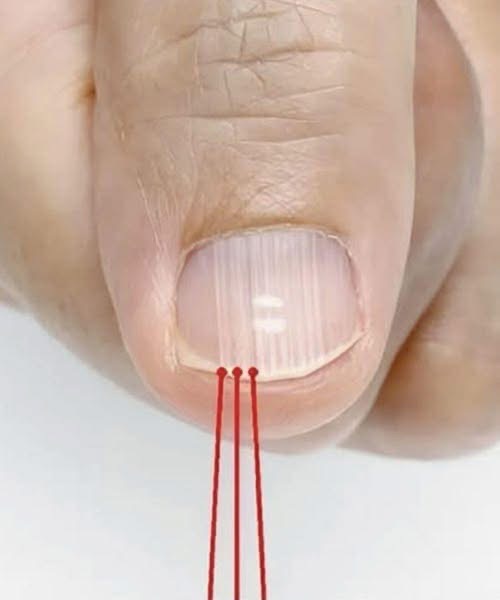
If you have these lines on your nails after 40, it is a clear sign that..

  • Horizontal lines (Beau’s lines): These can suggest past illness, significant stress, or chronic conditions such as diabetes or circulation issues.

  • Vertical ridges: While common with aging, unusually deep or uneven ridges could point to nutritional deficiencies like iron or vitamin B12 shortage.

  • Dark streaks: Sudden appearance of dark streaks may signal melanoma, a serious skin cancer, and require immediate medical attention.

  • White lines (Muehrcke’s lines): These may be linked to liver or kidney problems, or low protein levels.

Bottom line: After age 40, changes in your nails—especially unusual lines—should not be ignored. They can be an early warning from your body, so it’s important to consult a healthcare provider if you notice anything unusual. Your nails might be revealing health issues before other symptoms appear.